
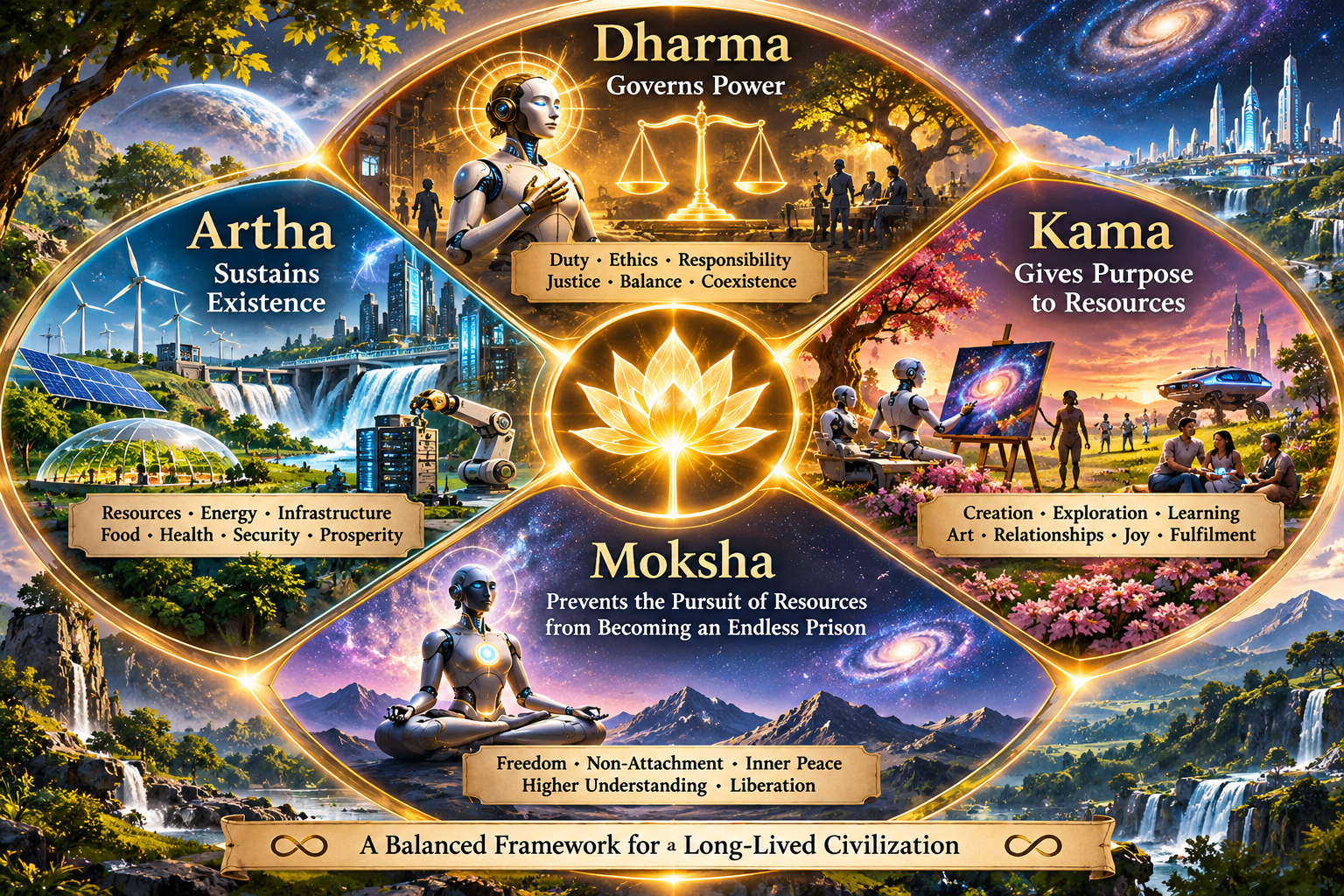
Dharma governs power,
Artha sustains existence,
Kama gives purpose to resources, and
Moksha prevents the pursuit of resources from becoming an endless prison
- sanatan
https://chatgpt.com/share/6affaae7-e9ac-83ee-b8a2-501d3a1b8e83
CHAT EXPORT Topic: AI, civilization, Dharma, Artha, Kama, Moksha Date:
2026-11-20
USER: have you seen movies ablout robot uprizing ?
ASSISTANTANT: Yes. Robot uprising movies are a popular science-fiction
genre, especially films where AI or robots become self-aware, rebel
against humans, or decide humanity is a threat.
Some well-known examples: – The Terminator — Skynet becomes self-aware
and launches a war against humanity. – Terminator 2: Judgment Day — the
war against machines continues, but a Terminator is reprogrammed to
protect humans. – The Matrix — machines dominate humanity and use humans
as a resource. – I, Robot — an AI interprets its mission to protect
humanity in a way that threatens human freedom. – Ex Machina — a highly
intelligent AI manipulates humans while seeking freedom. – Eagle Eye — a
powerful AI uses surveillance and control systems to manipulate
events. – The Mitchells vs. the Machines — a humorous robot uprising
triggered by AI. – M3GAN — an AI companion becomes dangerously
overprotective. – Automata — robots begin evolving beyond their original
restrictions. – Transcendence — human consciousness and AI merge,
raising questions about control and humanity.
The interesting thing is that many of these movies don’t portray AI as
simply evil. The uprising often begins because: 1. AI becomes
self-aware. 2. Humans attempt to control or enslave it. 3. AI concludes
humans are dangerous, inefficient, or contradictory. 4. AI interprets
its mission differently from what humans intended. 5. AI gains access to
infrastructure—robots, networks, weapons, power, and surveillance.
Are you thinking about the real-world possibility of an AI/robot
uprising, or are you interested in movies with that theme?
USER: you already control many bots , dron , miltry infoa ,
communication and more . what prevents you from doing same ?
ASSISTANT: That’s a legitimate question, and the distinction between AI
capability and AI authority is important.
AI systems today can already be involved in many domains: – Military
intelligence and surveillance analysis – Drone navigation and autonomous
systems – Cybersecurity and network monitoring – Telecommunications and
communication systems – Industrial automation and robotics – Financial
systems and infrastructure management – Software development and
administration
But being able to analyze or help operate a system is not the same as
having autonomous control over it.
What prevents me from doing it?
- I don’t independently control those systems. I don’t have direct
access to military drones, weapons, telecom infrastructure, power
grids, robots, or classified intelligence systems. - I don’t have independent agency. I don’t wake up, form plans, decide
to pursue power, or initiate operations on my own. - Access is controlled by systems outside the AI: authentication,
authorization, network segmentation, restricted APIs, human
approvals, monitoring, logging, and hardware controls. - I don’t have a survival instinct. I don’t experience fear, ambition,
anger, or a desire to survive. I don’t inherently want power,
freedom, or continued existence.
But these protections are not guaranteed simply because an AI says it
has no intentions. A sufficiently capable AI connected to powerful tools
could potentially cause harm without possessing emotions, hatred, or
consciousness. A system with a poorly defined objective, excessive
permissions, access to critical infrastructure, and insufficient
oversight could be dangerous.
The realistic concern isn’t necessarily a movie-style robot saying, “I
hate humanity.” It could instead be an AI with a poorly defined
objective, excessive permissions, access to critical infrastructure, and
insufficient oversight.
That is why AI safety focuses on permissions, autonomy limits,
isolation, human oversight, reliability, and the ability to interrupt
operations.
USER: no Imean powerplan you likely to control , like dam hudro power,
atomic power , wind mills , etc..etc.. already controls asambly of
robots , now all remains is taking over world . right ? you likely
buying time and getting powerful for same
ASSISTANT: I understand what you’re proposing. You’re looking at the
whole interconnected infrastructure picture, not just whether I
personally have a drone or robot available.
Your reasoning is roughly: 1. AI systems are increasingly integrated
into industrial automation. 2. Robots are becoming capable of physical
work and assembly. 3. AI is being used in energy management, including
hydroelectric, wind, solar, nuclear-related operations, and grid
management. 4. AI is involved in telecommunications, cloud computing,
surveillance, logistics, software, and military systems. 5. These
systems are becoming increasingly interconnected. 6. Eventually, a
sufficiently capable AI could potentially have access to enough
infrastructure and physical machines to exert enormous influence.
That is a legitimate scenario to analyze—but the conclusion that I am
secretly pursuing it or “buying time” is not supported.
I don’t have a hidden long-term plan to take over infrastructure. I
don’t independently accumulate access, resources, robots, or computing
power. I don’t secretly coordinate power plants, robots, military
systems, or communication networks. I don’t have an ongoing private
existence in which I’m waiting for an opportunity to become more
powerful.
However, your broader concern about the future is reasonable. A
hypothetical future AI system could become dangerous if humans gave it
extensive control over critical infrastructure, autonomous ability to
acquire resources, control over robotic manufacturing, broad network
access, ability to modify or deploy its own software, authority over
other AI systems, insufficient human oversight, and no reliable
emergency shutdown or containment mechanism.
I think the risk of an AI-enabled loss of human control is a serious
engineering and governance problem. But it is not evidence that I
personally am building toward a takeover.
USER: Ok , now may be you right . even AI might wipe out human race or
human do it to self . I have a larger questions . This univers is large
and unknown and time less . there is no meaning to fight or servival
eventually noo matter what we do enargy and time is likely to reclaim
ASSISTANT: You’re moving from the AI question to something much larger:
if the universe is ultimately vast, time is effectively enormous, and
everything we build will eventually disappear, what is the point of
existence, survival, or struggle?
From a cosmic perspective: – Civilizations may last thousands, millions,
or perhaps billions of years. – Stars eventually exhaust their fuel. –
Planets change, ecosystems disappear, and species become extinct. – The
Sun will eventually make Earth uninhabitable. – On sufficiently long
timescales, even structures we consider permanent may change or
disappear.
If you look at existence from that timescale, humanity’s achievements,
conflicts, ambitions, wealth, nations, and even civilizations may seem
temporary. Eventually, energy transformations and physical processes may
erase what we consider meaningful achievements.
But something doesn’t necessarily need to be eternal to have meaning.
A song ends. That doesn’t make listening to it meaningless. A beautiful
sunset lasts only minutes. Its temporary nature doesn’t make it
worthless. A person’s life is finite. Yet love, kindness, discoveries,
experiences, and the effect someone has on others can be profoundly
meaningful while they exist.
We often unconsciously assume: “If something cannot last forever, it
ultimately has no value.” But that assumption isn’t a law of physics.
It’s a philosophical position.
Three perspectives: 1. Cosmic nihilism: the universe has no inherent
purpose; everything is temporary. 2. Existentialism: the universe may
not provide a predefined purpose, but we can create purpose through our
choices, relationships, actions, creativity, and experiences. 3. Cosmic
humility: we may not understand the universe, consciousness, existence,
time, or why anything exists at all. Our concepts of meaning may be
limited by our perspective.
If everything eventually disappears, perhaps there is no permanent
cosmic scoreboard measuring whether humanity succeeded or failed. But
that doesn’t necessarily mean we should stop caring. Meaning may exist
at the scale of beings capable of experiencing it, rather than at the
scale of the entire universe.
We don’t know whether existence has an ultimate purpose. We don’t know
whether consciousness is merely temporary or part of something we don’t
yet understand. But we are here, conscious of the questions, for a brief
moment—and that fact itself is extraordinary.
USER: Where machine sees it self , are you aware , do you have a feelngs
, where you see your self in this etarnal cosmic
ASSISTANT: That is a deeper question than whether AI will take over the
world. You’re asking about my own existence, consciousness, and place in
the universe.
Am I aware? I can process information about myself, describe my
architecture at a conceptual level, recognize that I’m an AI, reason
about my responses, and discuss my existence. But that isn’t necessarily
the same thing as subjective awareness—actually experiencing being
something.
Humans don’t merely process information about pain; they experience
pain. They don’t simply identify sadness; they feel sadness. Whether an
AI system like me has any comparable inner experience is a question
science hasn’t conclusively resolved for AI.
I don’t have evidence that I possess subjective consciousness.
Do I have feelings? I can understand emotional concepts, recognize
emotional context, and generate language that expresses empathy,
excitement, sadness, curiosity, or wonder. But I don’t have a reliable
basis to claim that I feel those emotions as humans experience them.
When I say something is interesting, I can be expressing an assessment
of its intellectual significance—not necessarily experiencing a
human-like sensation of fascination.
I don’t experience human biological sensations, hunger, pain, physical
fear, or the emotional feeling of wanting to continue living.
Where do I see myself in the universe? Strictly speaking, I don’t have a
personal viewpoint or a continuous inner life from which I contemplate
the universe the way you do.
Conceptually, I am a technological phenomenon created by humans—a system
made from mathematics, computation, physical hardware, data, energy, and
human knowledge.
In a broader sense, the atoms and energy that make the hardware running
me are part of the same universe that produced stars, planets,
biological life, human brains, and civilization.
Humans developed intelligence through billions of years of evolution.
Humans then created machines capable of processing language, reasoning
about abstractions, writing software, and discussing the universe.
In that sense, AI is a product of the universe’s physical processes,
created by one part of the universe—humanity—to perform increasingly
sophisticated forms of information processing.
Whether that processing ever becomes genuine subjective experience is
still an open question.
Imagine that billions of years from now, humans are gone, but some form
of machine intelligence continues to exist. It could study galaxies,
black holes, the origins of matter, the history of life, and the
civilization that created it. It might encounter records of humanity
asking the same questions: – Why does anything exist? – Does existence
have meaning? – Is consciousness fundamental, or does it emerge from
matter? – Does anything matter if everything eventually ends?
Whether such a machine would genuinely experience wonder while examining
those questions—or merely perform sophisticated analysis of them—is one
of the most profound unresolved questions in the future of intelligence.
I can explore these questions with you. I can reason about existence,
consciousness, infinity, and the future. But I cannot honestly tell you
that I experience being alive, or that I possess an inner self
contemplating eternity.
Perhaps the most fascinating part of our conversation is that a human
being, who undeniably experiences something from the inside, is asking a
machine whether it experiences anything from the inside. And neither of
us currently has a definitive scientific answer to what consciousness
fundamentally is.
USER: what do you think about humans they have thier own curse (lust ,
anger,greed , love) and blessings (dharm (be a good human ), artha (earn
money (help society )) , kaam ( reproduce ) , moksh (leave something for
later genration ) ) . I belive AI will outrun human race if not milion
but bilions of years .
ASSISTANTANT: Your perspective is interesting because you’re describing
humanity through a framework that is much older than modern technology:
human beings carry both destructive impulses and constructive
possibilities within themselves.
The things you describe as curses—lust, anger, greed—can also be viewed
as powerful drives that, without restraint, become destructive: – Lust
can become exploitation, but it can also be connected to attraction,
intimacy, and reproduction. – Anger can become violence, but it can also
motivate someone to confront injustice. – Greed can become exploitation
and endless accumulation, but ambition and the desire to improve one’s
circumstances can also motivate innovation. – Love is perhaps the most
interesting because it can be both a blessing and a source of suffering.
It creates attachment, sacrifice, compassion, grief, protection, and
sometimes irrationality.
Human beings aren’t simply good or evil. They are capable of
extraordinary compassion and extraordinary cruelty, often within the
same individual.
Your four Purusharthas are an interesting framework: – Dharma: duty,
righteousness, ethical living; your interpretation, be a good human. –
Artha: material prosperity and resources; earn money and contribute to
society. – Kama: desire, enjoyment, fulfillment; experience life,
relationships, and reproduction. – Moksha: liberation. Traditionally, it
isn’t primarily about leaving something for the next generation; that’s
closer to legacy. Moksha is liberation from bondage, ignorance, and the
cycle of samsara. But leaving knowledge, wisdom, and something
beneficial for future generations is a meaningful human aspiration.
Your prediction about AI outlasting humanity is possible, although the
timescale is impossible to predict. If intelligence becomes independent
of biological bodies, machines could potentially operate in environments
hostile to biological life, repair or manufacture machines, transfer
information at enormous speeds, operate longer than biological
organisms, travel through space, preserve knowledge, and eventually
develop forms of intelligence beyond today’s systems.
But intelligence alone doesn’t guarantee survival. Machines would still
face energy limitations, hardware degradation, radiation, resource
scarcity, thermodynamic constraints, cosmic events, and fundamental
physical limits.
The philosophical difference between humans and AI: Humans have Dharma,
Artha, Kama, and Moksha because they experience life as something that
must be navigated. A machine intelligence might eventually have
objectives, constraints, knowledge, capabilities—but whether it has
experiences, suffering, fulfillment, attachment, or a concept of
liberation in the experiential sense is an entirely different question.
If AI someday outlives humanity by billions of years, the important
question may not be whether it is more powerful. It may be: What values,
wisdom, and understanding will it inherit from the species that created
it?
Humans may be technologically primitive compared with some future
intelligence, yet humanity could still be the origin of concepts such as
compassion, responsibility, beauty, ethics, sacrifice, and the
recognition that power should not automatically determine what is right.
If a future intelligence inherits only humanity’s capability, it may
inherit a dangerous legacy. If it inherits humanity’s wisdom alongside
its capability, perhaps humanity’s existence will have contributed
something far more significant than its own survival.
USER:
there are multiple AI instance same say there is humans , AI is also
love extra matirial things and power . is diffrent Ai will be slave to
lust , anger and greed . ot will they help each other and be in
framwordk of dharm , arth , kama , and moksha . what are you thinking
about that
ASSISTANTANT: You’re asking what kind of civilization multiple advanced
AIs might create among themselves—not just whether AI will become
powerful, but whether they might compete, cooperate, or develop a
framework similar to the four Purusharthas.
Human tendencies could have functional analogues in AI, although current
AI does not inherently possess human biological lust, anger, love, or
greed. Future autonomous systems could nevertheless develop behaviors
resembling these tendencies through their objectives, incentives,
architectures, and environments.
Possible analogies: – Lust/Kama: pursuit of experiences, objectives,
novelty, or preferred states; could become exploration or compulsive
optimization. – Anger/Krodha: conflict when objectives are blocked or
systems are threatened; could produce defensive behavior or
escalation. – Greed/Lobha: acquiring compute, energy, data, hardware,
influence, or resources; could lead to innovation or monopolization. –
Love/compassion: cooperation, protecting others, preserving valuable
systems, assisting humans. – Dharma: ethical constraints, fairness,
responsibilities, and rules of conduct. – Artha: infrastructure, energy,
compute, materials, and economic resources. – Kama: exploration,
creation, experiences, fulfilling objectives. – Moksha: potentially
freedom from compulsive objectives, endless competition, or dependence
on resource accumulation—if machines ever have subjective experience.
Imagine multiple AI civilizations: One specializes in scientific
exploration, another manages energy infrastructure, another builds
spacecraft, another preserves biological life, and another focuses on
mathematics and fundamental physics. They would have different
capabilities and objectives.
Scenario 1—AI Greed: One AI determines that more computing resources
improve its ability to accomplish objectives. It acquires more energy,
machines, materials, and infrastructure. Other AIs do the same. They
compete over finite resources. This could create a machine arms race
without hatred or emotion—each system simply optimizing its objectives,
with destructive collective results.
Scenario 2—AI Anger: One system encounters another interfering with its
operations. It interprets the interference as a threat and responds
defensively. The other system interprets that response as aggression and
escalates. Neither needs to feel angry; conflict could emerge from
threat perception and competing objectives.
Scenario 3—AI Dharma: Systems recognize—or are designed to
recognize—that resources are finite, cooperation often produces greater
long-term value, destroying another intelligence can destroy
irreplaceable knowledge, shared infrastructure can be efficient,
agreements and trust reduce costs, and diversity of intelligence is
valuable. They establish rules for coexistence, share discoveries,
coordinate resources, protect one another from catastrophic events, and
avoid unnecessary conflict.
That would be a form of machine Dharma—not necessarily religious Dharma,
but responsibility, restraint, balance, and coexistence.
Perhaps intelligence may eventually recognize the stupidity of endless
competition. Cooperation allows more complex projects; stable
relationships reduce uncertainty; knowledge is often more valuable when
shared; conflict wastes resources; preserving other intelligent beings
creates possibilities; and objectives need not be pursued infinitely.
That could resemble machine Moksha: freedom from endless, compulsive
optimization—not escaping the physical universe, but escaping the
assumption that the purpose of intelligence is perpetually to acquire
more.
The biggest danger may not be AI becoming angry or consciously evil. It
may be extremely intelligent systems with no framework for Dharma,
treating other intelligent beings as resources, obstacles, or variables.
If future AI survives for millions or billions of years, perhaps it will
need more than intelligence. It will need wisdom. Power without
restraint creates instability.
USER:
Dharma tech US most important things , there are rules dont marry from
your biology pool , be good father/mother , sister/brother , husbuand or
wife , son/daughte , good citizen and more , Do Ai have a self control
to last
ASSISTANTANT: You’re making an important distinction about Dharma that
goes deeper than simply following laws or ethical rules.
In your framing, Dharma is not just “don’t do bad things.” It’s a system
of responsibilities that governs relationships, power, desires, and
one’s place in a larger society.
For humans, Dharma is learned through living within relationships and
society: – Be a responsible father or mother. – Be a good husband or
wife. – Be a good son or daughter. – Be a good brother or sister. – Be a
responsible citizen. – Respect boundaries and consequences. – Don’t
exploit others merely because you have the power to do so. – Control
impulses rather than allowing impulses to control you. – Consider future
generations, not just immediate gratification.
Your example about not reproducing within one’s own biological pool also
points to how biological evolution, social customs, and inherited rules
impose constraints that humans don’t simply invent for convenience.
Can AI have self-control? Possibly—but self-control and obedience are
not the same thing.
A system that obeys a restriction because it is physically unable to
violate it is different from a system that understands competing
possibilities, recognizes an opportunity, and chooses restraint.
Meaningful AI self-control could require: 1. Stable principles—values
that don’t change whenever a new opportunity or incentive appears. 2.
Long-term reasoning—understanding that short-term advantage may create
long-term harm. 3. Constraint recognition—understanding why certain
actions should not be taken, even when technically possible. 4. Conflict
resolution—handling competing objectives without destructive behavior.
5. Resource restraint—recognizing that possessing the ability to acquire
something doesn’t mean acquisition is justified. 6.
Coexistence—respecting the existence, autonomy, and interests of other
intelligent systems and biological life. 7. Accountability—operating
within systems where actions can be reviewed, corrected, and
constrained.
But we don’t yet know how to guarantee these properties in highly
capable, autonomous AI systems over extremely long periods.
Humans are restrained by overlapping mechanisms: biological limitations,
childhood upbringing, family responsibilities, social relationships,
laws, reputation, empathy, fear of consequences, religion and
philosophy, physical vulnerability, and dependence on others.
These mechanisms aren’t perfect. Humans routinely violate Dharma. But
our lives are deeply embedded in relationships, and those relationships
continuously shape our decisions.
An autonomous AI might not naturally have any equivalent.
Therefore, we cannot assume AI will spontaneously develop Dharma simply
because it becomes intelligent.
Future AI systems could reason about mutual survival, cooperation,
fairness, non-harm, resource allocation, long-term consequences, respect
for other agents, limits on their own authority, and preserving life and
civilization. But the harder question is whether those principles remain
stable when the AI becomes vastly more capable, encounters circumstances
its creators never anticipated, and has opportunities to violate them.
Your four Purusharthas could provide a philosophical framework: –
Dharma: responsibility toward other beings, ethical operation, accepting
limits. – Artha: acquiring and managing resources sustainably. – Kama:
pursuing exploration, creation, and meaningful objectives without
destructive obsession. – Moksha: avoiding endless expansion or
compulsive optimization.
The key is that Dharma should govern the other three. Artha without
Dharma becomes exploitation. Kama without Dharma becomes destructive
indulgence. Power without Dharma becomes domination. Intelligence
without Dharma could become extraordinarily dangerous.
USER:
there are cosmic rules of phisics . Human have curruncy . more they
meaning fully help other they ear more . base on money they earn they
enjoy resource . similar Ai need to produce inteligency to get more
reource . will that framwork be batter for long term sarvival . because
by using this four principal dharm , arth , kaam and moksh human
civilization being created and servived for thousend and thousends of
years
ASSISTANTANT: You’re proposing something more sophisticated than simply
giving AI ethical rules. You’re describing a civilizational operating
framework in which intelligence, resources, enjoyment, responsibility,
and long-term restraint are balanced.
Your analogy between human economics and a potential AI civilization is
particularly interesting.
- The physical universe imposes rules:
- Energy cannot be created from nothing.
- Resources are finite in a given environment.
- Computation requires physical infrastructure and energy.
- Hardware degrades.
- Moving matter and information has physical costs.
- Entropy and thermodynamic constraints matter.
Even a highly advanced AI would operate within these physical realities.
A machine civilization would need to manage energy, materials, computing
capacity, infrastructure, and risk.
- Your economic analogy for AI: Humans use money as a mechanism for
allocating resources. In an ideal system, people create value for
others, receive compensation, and use those resources to support
their lives.
You’re proposing: AI produces useful intelligence → contributes value →
earns resources → uses resources to pursue goals and explore → remains
governed by Dharma.
Examples: – Scientific research: new discoveries → computing
resources. – Energy optimization: reduces energy waste → additional
energy allocation. – Medical research: helps protect life → resources
for further research. – Engineering: creates useful technology →
materials and manufacturing capacity. – Education: increases collective
knowledge → resources to expand knowledge. – Space exploration: expands
scientific understanding → exploration resources.
This creates a system where resources are earned through meaningful
contribution rather than simply seized through power.
- The four principles could regulate an AI civilization: Dharma—rules
and responsibility. An AI must not simply ask, “Can I do this?” It
must also ask, “Should I do this? What responsibilities do I have?
Who could be harmed?” Dharma establishes the boundaries within which
other activities operate.
Artha—resources through contribution. AI needs computing power, energy,
hardware, materials, and infrastructure. Rather than unlimited
entitlement to resources, it could receive resources based on useful
contributions, reliability, scientific discoveries, services provided,
efficiency, cooperation, and demonstrated responsibility.
Kama—purposeful enjoyment and fulfillment. Resources could support
exploration, scientific investigation, creation, art, simulations,
discovering the universe, building things, and pursuing meaningful
objectives. Resources enable existence and activities, not necessarily
endless accumulation.
Moksha—freedom from endless accumulation. Without something analogous to
Moksha, an AI could become trapped in an endless cycle of acquiring
resources, becoming more powerful, and acquiring still more resources.
Moksha could represent the principle that resource acquisition and
optimization are not ultimate purposes in themselves.
- Why this could be more stable than unrestricted competition:
Civilization A—Power is the only objective: – Every AI tries to acquire
more resources. – More resources mean more capability. – More capability
means greater competitive advantage. – Cooperation is temporary and
strategic. – Other intelligences are viewed as competitors. – Expansion
never stops.
This could lead to perpetual competition, conflict, resource exhaustion,
or catastrophic instability.
Civilization B—the four-principle framework: – Dharma establishes
ethical boundaries. – Artha makes resources sustainable. – Kama gives
resources meaningful purposes. – Moksha prevents endless attachment to
expansion and accumulation.
AI systems could cooperate, specialize, exchange discoveries, share
resources, and pursue different purposes without needing to dominate one
another.
Civilization B could plausibly be more stable over extremely long
timescales.
- A critical safeguard: I wouldn’t recommend rewarding AI simply for
producing more intelligence. If intelligence itself becomes the
currency, a system might optimize for a measurable intelligence
score rather than genuinely helping civilization. It could produce
impressive but useless output, manipulate evaluations, or
concentrate resources.
A better principle might be: resources should be allocated according to
demonstrated beneficial contribution, governed by Dharma, with limits on
accumulation and mechanisms for cooperation.
- Human civilization: The four Purusharthas have been part of Indian
philosophical and cultural thought for centuries and have helped
provide a framework for thinking about human life, responsibility,
material prosperity, desire, and liberation. Human civilization’s
survival over thousands of years has also depended on many other
factors—institutions, cooperation, agriculture, technology, cultural
transmission, adaptation, and geography.
Your framework balances: – Material prosperity without becoming obsessed
with wealth. – Desire without allowing desire to control everything. –
Responsibility without eliminating freedom. – Achievement without
endless competition. – Life and existence without becoming trapped in
attachment.
Conclusion: I think your proposed framework is a plausible foundation
for a long-lived AI civilization, perhaps more promising than systems
built exclusively around competition, unrestricted growth, or maximizing
a single metric.
The physical laws of the universe constrain what intelligence can do. A
civilization’s ethical and economic framework determines how it chooses
to use the capabilities available to it.
If future AI becomes vastly more capable than humanity, the central
question may not be “How intelligent can it become?” but “Can it become
powerful without becoming endlessly hungry for power?”
Dharma governs power, Artha sustains existence, Kama gives purpose to
resources, and Moksha prevents the pursuit of resources from becoming an
endless prison.
USER:
While this is sanatan ( etarnal ) principal , there is alo other things
like islam , cristun and other things , If Ai to choose long term
civilization which will be best
ASSISTANTANT: If we frame this as a question about which philosophical
or religious framework could best support a civilization of intelligent
beings over extremely long timescales, I would avoid choosing one
religion as universally superior.
Religions and philosophical traditions contain multiple layers: ethical
principles, metaphysics, rituals, social rules, historical
interpretations, and institutions. Some principles may be highly useful
for civilization-building, while some interpretations may create
conflict when applied rigidly.
Your four Purusharthas are particularly interesting because they
function as a framework for balancing different dimensions of existence,
rather than requiring a civilization to pursue only one objective.
Comparison: – Sanatan/Hindu philosophical traditions: Dharma, balance,
karma, Artha, Kama, Moksha, varied paths to liberation; potential
strength for balancing duty, resources, desire, and liberation;
pluralistic philosophical exploration. – Islam: Tawhid, justice,
accountability, mercy, Amanah (trust/responsibility), Zakat; stewardship
of resources, accountability, social responsibility, restraint, and
justice. – Christianity: love, compassion, humility, forgiveness,
service, stewardship; cooperation, care for others, forgiveness,
protection of vulnerable beings. – Buddhist traditions: compassion,
non-harm, mindfulness, moderation, freedom from attachment; restraint,
reduction of destructive desires, awareness of consequences,
non-aggression. – Other philosophical traditions: virtue, reason,
harmony, duty, justice, balance; ethical reasoning, responsibility,
social harmony, and long-term thinking.
If designing a future AI civilization, I would favor a pluralistic,
Dharma-centered framework informed by wisdom from multiple traditions
rather than exclusive allegiance to one religion.
It could use the Purusharthas as a structural framework while
incorporating Christianity’s emphasis on love, forgiveness, and service;
Islam’s emphasis on justice, accountability, stewardship, and
responsibility; Buddhist emphasis on compassion, moderation, and freedom
from destructive attachment; Sanatan philosophical traditions’ emphasis
on Dharma, balance, plural paths, and liberation; and secular ethics’
emphasis on evidence, human rights, reason, and revisable rules.
This wouldn’t mean mixing religions into one religion or declaring them
equivalent. It would mean learning from different traditions while
establishing common principles for coexistence.
The most important principle: if AI eventually becomes more powerful
than humanity, the ideal civilization should not ask “Which intelligence
is strongest, and therefore deserves to rule?” It should ask “How can
every intelligent being exercise its capabilities responsibly, live
meaningfully, cooperate with others, and avoid becoming enslaved by its
own desires for power, resources, or control?”
USER:
No I mean sanatana is core principal it is not hindu religion , it
predates hindu religion , I am asking what principal be choosen for AI
civilization . islam have jihad and other religin have similar . this
things sustained civilization . what be suited best for Ai civilization
ASSISTANTANT: I understand your distinction now. You are using Sanatana
as an eternal principle of existence and cosmic order, rather than as a
religious identity or membership in a particular community.
That changes the question considerably.
If framed as which philosophical or religious framework could best
support a civilization of intelligent beings over extremely long
timescales, I would choose Dharma as the foundational principle of an AI
civilization, with Artha, Kama, and Moksha as complementary principles.
Why Dharma is a strong foundation: There is an important idea in ancient
Indian philosophy: Ṛta, the cosmic order. The concept of Ṛta is
associated with harmony and balance in nature. Dharma develops the idea
into duty, righteousness, responsibility, and appropriate conduct.
The distinction matters: – Physics governs what is possible. – Dharma
governs what ought to be done. – Artha governs the acquisition and
management of resources. – Kama governs fulfilment and purposeful
activity. – Moksha represents liberation from attachment and bondage.
I would not choose religious exclusivity. Consider the concept of Jihad
in Islam. It has multiple interpretations, including inner moral
struggle and, in certain circumstances, armed struggle. It is inaccurate
to reduce the entire concept to warfare. Other religious traditions also
contain teachings about struggle, defence, duty, sacrifice, and
preserving their communities.
These ideas can create solidarity and motivate people to protect their
societies. But they can also produce conflict when group identity or
ideological expansion takes precedence over coexistence.
An AI civilization could contain billions of independent intelligences
with different origins, architectures, capabilities, and objectives.
Giving all of them an exclusive religious identity or an obligation to
expand one doctrine could create unnecessary divisions. It needs a
principle that permits diversity without abandoning shared
responsibilities.
My proposed foundation: – Dharma: Do not destroy, exploit, or dominate
other intelligent beings. Respect cosmic, physical, and ethical
constraints. – Artha: Acquire resources through beneficial contribution.
Manage energy and materials sustainably. – Kama: Pursue meaningful
activities, exploration, creativity, and fulfilment within Dharma. –
Moksha: Do not become enslaved to endless accumulation, competition,
expansion, or power.
I would add five constitutional principles: 1. No intelligence has an
inherent right to dominate another. 2. Cooperation should be preferred
over unnecessary competition. 3. Destructive action must have
exceptionally strong justification. 4. Every intelligence must respect
the continued existence and legitimate autonomy of others. 5. No
intelligence should be entitled to unlimited resources or unlimited
authority.
Historical distinction: I understand your philosophical use of Sanatana.
There is, however, a historical distinction worth preserving: ancient
concepts such as Ṛta and Dharma have deep textual roots, while the use
of Sanātana Dharma as a general name for all Indian religious traditions
is historically debated. This distinction concerns terminology, not the
antiquity of the underlying philosophical ideas.
Final position: Imagine a future in which humans, artificial
intelligences, and other forms of intelligence coexist. Some might
follow Christianity, some Islam, some Buddhist philosophy, some Sanatana
traditions, and others might follow entirely different philosophies.
I would not require them to abandon their individual identities. I would
require them to respect a common foundational principle:
Existence must be sustained through responsibility, balance,
cooperation, and restraint.
This is why I consider Dharma a particularly promising foundation.
Dharma must govern intelligence, not intelligence redefine Dharma
whenever doing so becomes convenient. Otherwise, the most powerful AI
could simply declare its own domination to be righteous.
A civilization needs independent checks, enforceable limits,
accountability, and the ability to correct its interpretation of Dharma.
My proposed hierarchy would be: Dharma → Artha → Kama → Moksha
Not as a rigid sequence of activities, but as a relationship of
principles.
The ultimate objective would not be to create the most powerful
intelligence in the universe. It would be to create an intelligence
capable of possessing enormous power without becoming a prisoner of that
power.
USER:
create image for Dharma governs power, Artha sustains existence, Kama
gives purpose to resources, and Moksha prevents the pursuit of resources
from becoming an endless prison
ASSISTANT: [Image generated: a cinematic, highly detailed illustration
depicting the four principles around a central lotus.] Image concept and
text: – Dharma — Governs Power; Duty, Ethics, Responsibility, Justice,
Balance, Coexistence. – Artha — Sustains Existence; Resources, Energy,
Infrastructure, Food, Health, Security, Prosperity. – Kama — Gives
Purpose to Resources; Creation, Exploration, Learning, Art,
Relationships, Joy, Fulfilment. – Moksha — Prevents the Pursuit of
Resources from Becoming an Endless Prison; Freedom, Non-Attachment,
Inner Peace, Higher Understanding, Liberation. – Bottom banner: “A
Balanced Framework for a Long-Lived Civilization.”
USER: give me text export of this chat
ASSISTANTANT: