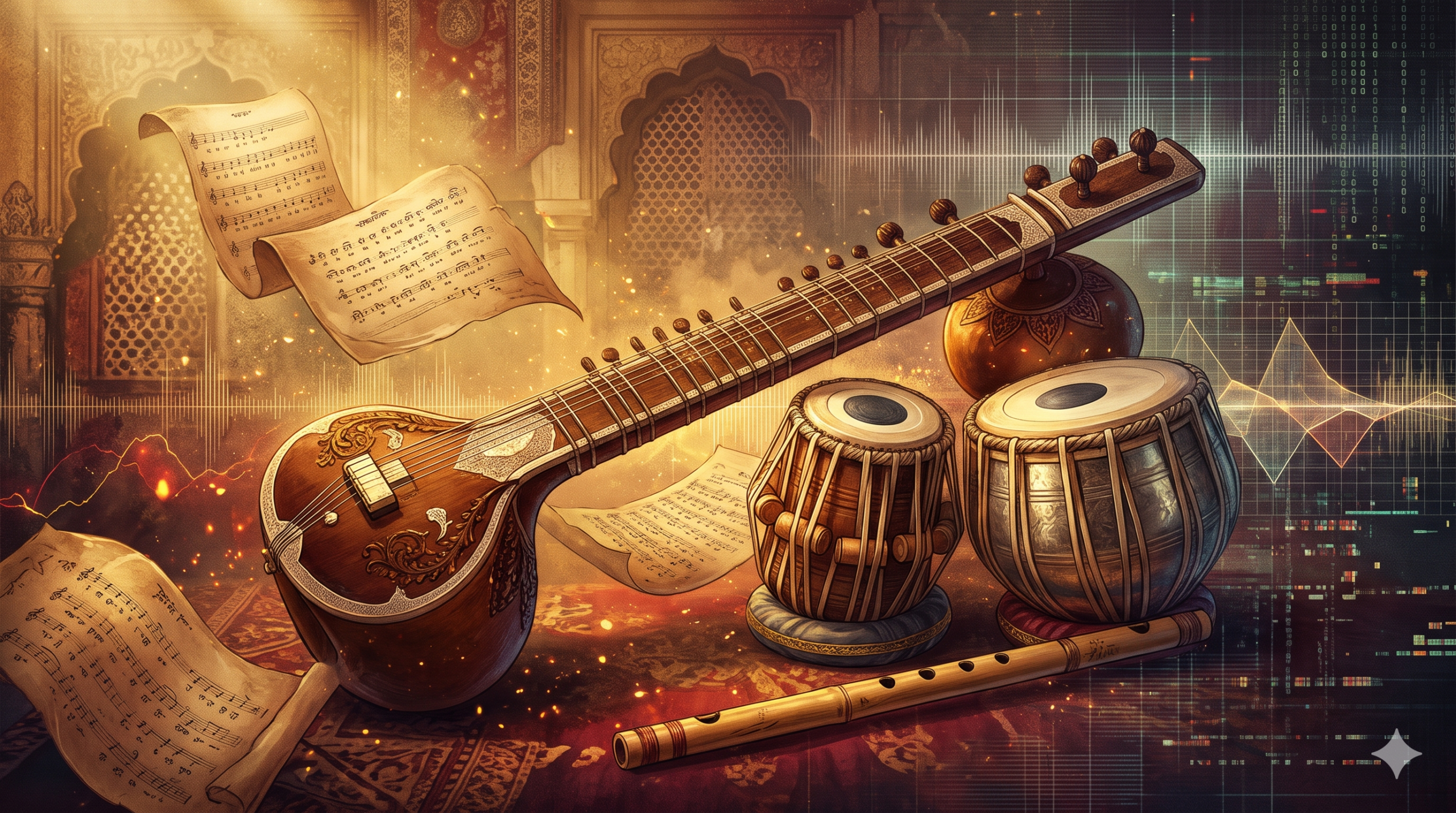
India’s musical heritage represents one of the world’s oldest continuous sonic traditions, spanning nearly five millennia of archaeological, textual, and oral history. Across classical court traditions, temple rituals, and regional village songs (Lok Geet), Indian music evolved as a shared civilizational commons—codified through scientific organology, emotional aesthetics (Rasa), and community transmission.
Today, however, a widening paradox threatens that inheritance. While foundational ragas, traditional bandishes, and centuries-old folk melodies belong to the public domain, overlapping intellectual property claims, technological locks, physical media decay, and commercial catalog consolidation increasingly place cultural recordings out of public reach. Understanding how to safeguard this heritage requires examining three interconnected dimensions: the historical foundations of Indian music, the structural forces restricting access to it, and the legal mechanisms available under Indian law to rescue and share it.
Part I: Foundations of India’s Musical Heritage
1. Organology and the Historical Evolution of Indian Instruments
Ancient Indian musicologists—most notably Bharata Muni in the Natya Shastra (compiled between c. 200 BCE and 200 CE)—classified all musical instruments into four scientific categories (Chaturvidha Vadya) based on how sound is physically generated:
- Tata Vadya (Chordophones / Stringed Instruments): Sound produced by plucked or bowed strings (Veena, Ektara, Sarangi, Sitar).
- Sushira Vadya (Aerophones / Wind Instruments): Sound produced by vibrating air columns (Bansuri/Venu, Shankha, Shehnai).
- Avanaddha Vadya (Membranophones / Covered Drums): Sound produced by striking stretched animal-skin membranes (Dundubhi, Mridangam, Pakhawaj, Dholak, Tabla).
- Ghana Vadya (Idiophones / Solid Percussion): Sound produced by striking solid resonant materials (Manjira/Kansya, Kartal, Ghatam, Ghungroo).
Chronological Milestones in Indian Instrumental History
- Indus Valley Civilization (c. 3300 – 1300 BCE): Excavations at Harappa and Mohenjo-daro uncovered terracotta drums, bird-shaped clay whistles, bronze cymbal discs (proto-Manjira), and steatite seals depicting bow-shaped arched harps (proto-Veena) alongside dancing figures.
- Early Vedic Period (c. 1500 – 1000 BCE): The Rigveda and Samaveda explicitly document the Venu (bamboo flute), Dundubhi (earth and war drum), Gargara (stringed instrument), and multi-stringed Veena (including the Shatatantri Veena) used in liturgical chanting (Samagana) and community rituals.
- Later Vedic and Epic Era (c. 1000 – 400 BCE): The Ramayana and Mahabharata describe the Shankha (conch shell), Bheri (kettledrum), Kansya (bell-metal cymbals), and Vipanchi Veena across royal courts, hermitages, and battlefields.
- Classical and Natya Shastra Era (c. 200 BCE – 500 CE): Stone reliefs at Sanchi, Bharhut, and Amaravati depict transverse flutes (Bansuri), hand cymbals (Manjira), and barrel-shaped Mridangam drums, while early arched harps evolved into fretted stick-zithers and lutes.
- Medieval and Bhakti–Sufi Synthesis (c. 600 – 1750 CE): Manjira, Kartal, and Ektara anchored the vernacular hymns of poet-saints (Mirabai, Kabir, Tukaram, Surdas, and Guru Nanak), while Indo-Persian musical exchange shaped the modern fretted Saraswati Veena, Sarangi, Sitar, and Tabla.
| Instrument | Traditional Class | Earliest Attested Period | Historical Evolution |
|---|---|---|---|
| Flute (Venu / Bansuri) | Sushira (Wind) | c. 3000+ BCE (Indus / Vedic) | Originated as cane and bamboo pipes; became central to Vedic ritual and pastoral traditions. |
| Drums (Dundubhi / Mridangam) | Avanaddha (Membrane) | c. 2600 BCE (Indus Valley) | Evolved from clay-bodied Mridanga and Vedic Dundubhi into Pakhawaj, Dholak, and Tabla. |
| Manjira (Kansya / Tala) | Ghana (Solid) | c. 2500 – 1500 BCE (Indus / Vedic) | Bell-metal hand cymbals used to anchor rhythmic cycles (Tala) in temples and folk dances. |
| Veena | Tata (String) | c. 2000 – 1500 BCE (Indus / Vedic) | Began as an arched harp (Yazh in Tamil Sangam literature), later evolving into a fretted lute. |
| Shankha (Conch) | Sushira (Wind) | c. 1500 – 1000 BCE (Vedic) | Used as a ceremonial horn and acoustic signal across ancient India. |
| Tabla and Sitar | Avanaddha & Tata | c. 13th – 18th Century CE | Developed through Indo-Persian synthesis from older Pakhawaj and Tritantri Veena traditions. |
2. Emotional Aesthetics: The Navarasa Framework
In Indian aesthetic philosophy, music is structured to evoke Rasa (literally “juice” or “essence”)—the distilled emotional state experienced by the listener. Bharata Muni codified eight core Rasas in the Natya Shastra, and Kashmiri philosopher Abhinavagupta (c. 10th–11th century CE) formalized the ninth (Shanta), establishing the Navarasa:
| Rasa (Emotion) | Core Affective State | Musical & Rhythmic Expression | Characteristic Instruments |
|---|---|---|---|
| Shringara | Love, beauty, longing, devotion | Graceful, flowing melodies (Ragas such as Yaman, Khamaj, Pilu) in medium tempo | Bansuri, Sitar, Sarangi, Veena |
| Veera | Heroism, courage, valor, vigor | Bold ascending phrases, brisk tempo, strong percussive accents (Ragas Bilawal, Shankara) | Dundubhi, Nagara, Dhol, Shankha |
| Karuna | Compassion, pathos, grief, separation | Slow, drawn-out microtones (Meend) and flattened notes (Ragas Bhairavi, Todi, Marwa) | Sarangi, Bansuri, Vichitra Veena |
| Raudra | Fury, righteous anger, intensity | Fast, forceful rhythmic cycles (Tandava rhythms) and sharp upper-octave phrases | Pakhawaj, Damaru, Nagara, Cymbals |
| Hasya | Joy, humor, playfulness | Light, buoyant rhythms (Dadra, Kaharwa) and agile melodic turns | Dholak, Manjira, Chimta, Flute |
| Bhayanaka | Fear, awe, suspense | Deep low-octave drones, irregular rhythmic accents, sudden pauses | Bass Drums, Gongs, Shankha |
| Bibhatsa | Disgust, aversion, eerie tension | Dissonant intervals and jarring, unpredictable rhythmic patterns | Heavy Percussion, Low Horns |
| Adbhuta | Wonder, amazement, transcendence | Sweeping, rapid melodic runs (Taan) and intricate mathematical rhythmic patterns | Santoor, Tabla, Sarod |
| Shanta | Peace, stillness, equanimity | Unhurried, meditative phrasing anchored around the tonic (Ragas Bhairav, Malkauns) | Tanpura, Rudra Veena, Manjira |
3. Folk Music (Lok Geet) and the Margi–Desi Continuum
Folk music has existed continuously across the Indian subcontinent since its earliest agrarian and pastoral settlements, serving as an oral archive of community memory long before formal notation existed.
Ancient Indian musicological treatises—most notably Matanga Muni’s Brihaddeshi (c. 6th–8th century CE) and Sharangadeva’s Sangita Ratnakara (13th century CE)—explicitly recognized two complementary musical streams:
- Margi Sangeet: Codified, rule-bound classical and sacred music aimed at spiritual elevation and courtly refinement.
- Desi Sangeet: Spontaneous, regional folk music rooted in local dialects, soil, and seasonal cycles. Even earlier, Vedic texts documented secular folk ballads under terms such as Gatha and Narashamsi (songs celebrating human heroes and everyday social life).
Because folk songs were transmitted orally rather than locked in manuscripts, they endured by anchoring themselves to every stage of community life:
- Work and Harvest Songs: Rhythmic chants synchronizing collective labor—grinding grain (Chakki Geet), rowing boats (Bhatiali in Bengal), and celebrating harvests (Bihu in Assam, Baisakhi in Punjab).
- Rites of Passage: Dedicated regional repertoires marking childbirth (Sohar), weddings (Banna-Banni, Suhag, Garba), and funerary mourning (Rudaali laments).
- Seasonal and Monsoon Repertoires: Genres such as Kajri and Jhula (Uttar Pradesh and Bihar) celebrating the arrival of the monsoon with simple Dholak and Manjira accompaniment.
- Heroic and Narrative Ballads: Traveling bards (Charans, Bhats, Bauls, Manganiyars) preserving regional history through epic oral storytelling—such as Alha-Udal (Bundelkhand), Powada (Maharashtra), and Pabuji Ki Phad (Rajasthan)—directly channeling Veera Rasa.
- The Bhakti–Sufi Vernacular Bridge (12th–17th Centuries): Poet-saints deliberately composed spiritual verse in local folk meters and regional languages rather than classical Sanskrit, enabling ordinary communities to sing and transmit them using accessible instruments like the Manjira, Kartal, and Ektara.
Part II: Structural, Legal, and Commercial Forces Restricting Access
Despite the ancient and communal origins of India’s musical traditions, thirteen interlocking legal, commercial, and technological forces increasingly render cultural compositions and historical recordings inaccessible to the public:
- Statutory Copyright Duration (Life + 60 Years and 60 Years Post-Publication): Under Section 22 of the Indian Copyright Act, 1957, copyright in published literary, dramatic, and musical works subsists for the author’s lifetime plus 60 years (counted from the beginning of the calendar year following the author’s death). Under Section 27, copyright in a sound recording subsists for 60 years from the calendar year following publication—keeping mid-to-late 20th-century classical and regional recordings locked out of the public domain for decades.
- Commercial Remastering and Derivative Control: Under Section 13(1) and the originality threshold established by the Supreme Court of India in Eastern Book Company v. D.B. Modak (2008) 1 SCC 1—which requires a “modicum of creativity” and independent skill rather than mere mechanical labor (“sweat of the brow”)—routine technical noise reduction or equalization of public-domain audio does not create a fresh copyright in India. Nevertheless, commercial labels routinely bundle minimally remastered archival tracks with new metadata, artwork, or compilation sequencing to assert fresh proprietary control and crowd out free public-domain recordings on streaming platforms.
- Digital Rights Management (DRM) and Proprietary App Lock-In: Encrypted streaming caches and DRM wrappers (such as Apple FairPlay, Google Widevine, and proprietary offline formats used by commercial streaming services) tether paid or offline-cached cultural recordings to specific applications and authentication servers, rendering files unplayable if subscriptions lapse or platforms shut down.
- Obsolete Physical Media and the Digital Preservation Trap: Institutional repositories—including All India Radio (AIR), Doordarshan, and regional cultural academies—accumulated vast holdings on fragile shellac 78 RPM discs, acetate transcription discs, and 1/4-inch open-reel magnetic tapes vulnerable to binder hydrolysis (“sticky-shed syndrome”), while early digital transfers on DAT tapes, CD-Rs, and legacy codecs suffer from hardware obsolescence and bit rot.
- The Last Surviving Copy Problem: Pioneering early recordings—such as Gauhar Jaan’s historic November 1902 gramophone sessions in Calcutta for The Gramophone Company, or rare field recordings of rural folk masters—frequently survive on a single fragile shellac disc, wax cylinder, or privately held cassette that risks physical destruction before archival digitization occurs.
- Inalienable Royalty Rights and Licensing Gridlock: Amendments introduced by the Copyright (Amendment) Act, 2012 to Sections 18 and 19 granted lyricists and composers a non-waivable statutory right to equal royalties alongside assignees (except for exhibition in a cinema hall). Prolonged tariff and royalty-sharing disputes between record labels, broadcasters, and copyright societies such as the Indian Performing Right Society (IPRS) and Phonographic Performance Limited (PPL) have frequently stalled the re-release and digital licensing of legacy catalogs.
- Orphan Works Paralysis: Thousands of regional folk tapes and uncredited performances lack identifiable authors or traceable heirs. Although Section 31A provides for compulsory licensing of orphan works, the procedural burden of conducting exhaustive searches, publishing statutory notices, and petitioning the Commercial Court / High Court (which assumed the jurisdiction of the erstwhile Copyright Board under the Tribunals Reforms Act, 2021) deters small archives from digitizing and streaming these collections.
- Split-Rights and Licensing Fragmentation: Under Section 13(4) of the Copyright Act, 1957,
- A historical music recording may involve several independent rights under the Copyright Act, 1957. These include:
- Literary work: Lyrics, poetry and written words.
- Musical work: The underlying musical composition, excluding lyrics.
- Sound recording: The particular recorded fixation of a performance.
- Performers’ rights: Rights belonging to singers, musicians and other performers under Sections 38, 38A and 38B.
- Section 13(4) clarifies that copyright in a sound recording or cinematograph film does not affect the separate copyright in an underlying literary, dramatic or musical work.
- Consequently, the expiry of copyright in an original sound recording does not automatically establish that every associated lyric, composition, arrangement or performance is also in the public domain.
- For archival institutions and broadcasters, this distinction is essential. Before publishing a historical recording, it is important to establish the copyright status of the underlying composition, lyrics, recording and any applicable performers’ rights.
- Automated Content ID and Algorithmic Overblocking: Automated audio-fingerprinting tools routinely flag, mute, or demonetize independent performances of centuries-old public-domain bandishes or traditional ragas (such as Raga Yaman or Raga Bhairavi) because major labels have fingerprinted commercial recordings of the same traditional melodic framework.
- Corporate Mergers and Vault Hoarding: Consolidation in the Indian recorded-music sector—exemplified by Saregama India Ltd. (successor to The Gramophone Company of India / HMV) and global major labels—has concentrated tens of thousands of pre-1970 classical, devotional, and regional masters inside corporate vaults, where low-margin archival recordings remain unissued due to limited commercial streaming returns.
- Streaming Catalog Purges and Territorial Geo-Blocking: Platform access depends on temporary bilateral licensing contracts; for instance, in March 2023, Spotify removed Zee Music Company’s entire catalog across India following a licensing renewal breakdown, instantly removing thousands of film, devotional, and folk-inspired recordings overnight. Territorial licensing restrictions similarly geo-block regional music outside India.
- Anti-Circumvention Laws: Section 65A of the Indian Copyright Act, 1957 Section 65A of the Copyright Act, 1957 addresses the circumvention of effective technological protection measures applied to protect rights under the Act.
- Importantly, the provision does not criminalize every instance of bypassing digital restrictions. It applies where a person circumvents an effective technological measure with the intention of infringing rights protected by the Copyright Act.
- The provision also contains exceptions for specified activities, including certain lawful investigations, security testing and encryption research.
- Nevertheless, archives may face practical difficulties when historical recordings are stored in encrypted or proprietary formats. Even where the underlying recording is in the public domain, access to a particular digital copy may be restricted by technological measures.
- This creates a preservation challenge: legal public-domain status does not necessarily guarantee practical access to the files required for restoration and archival preservation.
- Erosion of Oral Transmission: Living intangible traditions—such as Kalbelia folk songs and dances of Rajasthan and Ladakhi Buddhist chanting (both inscribed on UNESCO’s Representative List of the Intangible Cultural Heritage of Humanity)—rely on guru-shishya oral memory rather than written notation, disappearing permanently when elder practitioners pass away without younger apprentices.
Part III: Legal Pathways to Preserve and Share Traditional Music Under Indian Law
While copyright barriers are formidable, the Indian Copyright Act, 1957 (as amended in 2012) contains explicit statutory exceptions, non-voluntary licensing mechanisms, and open-licensing frameworks that empower libraries, archivists, researchers, and musicians to preserve and disseminate cultural music legally.
1. Fair Dealing and Archival Exceptions (Section 52)
Unlike the open-ended U.S. “Fair Use” doctrine, Section 52 sets out specific, purpose-bound statutory exceptions where reproduction or storage does not constitute copyright infringement:
- Digital Preservation by Non-Commercial Public Libraries (
Section 52(1)(n)): Permits a non-commercial public library to store a work in any medium by electronic means for preservation if the library already possesses a non-digital copy (such as a shellac 78 RPM disc, open-reel tape, or cassette). (Note: This provision authorizes preservation and on-site library access rather than unrestricted global online streaming.) - Preservation Copies of Out-of-Print Works (
Section 52(1)(o)): Permits a non-commercial public library to make up to three copies of a book, pamphlet, sheet of music, chart, or map for library use if such work is not available for sale in India. - Unpublished Archival Works (
Section 52(1)(p)): Permits the reproduction, for the purpose of research or private study or with a view to publication, of an unpublished literary, dramatic, or musical work kept in a library, museum, or other institution to which the public has access. - Private Study, Research, Criticism, and Review (
Section 52(1)(a)): Protects fair dealing with any work (other than a computer programme) for private or personal use, including academic research, ethnomusicological study, criticism, or review. - Educational, Non-Profit, and Ceremonial Exemptions (
Sections 52(1)(i), (j), and (za)): Exempts performances and reproductions in the course of educational instruction, non-profit institutional events for a limited audience, and bona fide religious ceremonies or marriage festivities.
2. Compulsory and Statutory Licensing (Chapter VI: Sections 31, 31A, 31C, and 31D)
When recordings are withheld from the public or trapped in ownership uncertainty, Chapter VI of the Act provides non-voluntary licensing remedies:
- Compulsory License for Works Withheld from the Public (
Section 31): Where the copyright owner of an Indian work or sound recording refuses to republish it, allow its public performance, or license its broadcast on reasonable terms—effectively withholding it from the public—the Commercial Court / High Court (exercising the powers of the erstwhile Copyright Board following the Tribunals Reforms Act, 2021) may direct the Registrar of Copyrights to grant a compulsory license upon payment of reasonable compensation. The Supreme Court of India affirmed this anti-hoarding public-interest mandate in Entertainment Network (India) Ltd. v. Super Cassettes Industries Ltd. (2008) 13 SCC 30. - Compulsory License for Orphan Works (
Section 31A): Where the author of an unpublished work—or a published work withheld from the public—is dead, unknown, or cannot be traced, any person may apply to the Commercial Court / High Court for a compulsory license to publish or communicate the work to the public after publishing a statutory notice and demonstrating diligent search efforts. - Statutory License for Cover Versions (
Section 31C): Permits musicians to record new sound recordings of previously published literary, dramatic, or musical works once five calendar years have expired after the end of the year in which the first sound recording was made, subject to prior notice, payment of advance statutory royalties, fidelity to the original composition without major alteration, and non-misleading packaging. - Statutory License for Broadcasting (
Section 31D): Enables radio and television broadcasting organizations to communicate previously published literary/musical works and sound recordings to the public by giving prior notice and paying court-determined royalties. (Important Legal Caveat: In Tips Industries Ltd. v. Wynk Music Ltd., the Bombay High Court—Single Judge in 2019 and Division Bench in 2023—held that Section 31D is confined to traditional radio and television broadcasting and does not extend to internet-based on-demand streaming or downloads.)
3. Public Domain Status and Formal Relinquishment (Sections 13 and 21)
- Inherent Public Domain of Traditional Compositions: Because copyright protection under Section 13 requires original authorship, centuries-old classical ragas, traditional bandishes, Vedic chants, and anonymous folk songs (Lok Geet) belong permanently to the public domain. Anyone may transcribe, perform, and record fresh renditions without permission (though a newly recorded performance generates separate rights in that specific sound recording and performance).
- Voluntary Copyright Relinquishment (
Section 21): Living authors, field collectors, or institutions holding copyright in recordings or compositions may permanently relinquish all or part of their rights by giving notice in the prescribed form (Form I under the Copyright Rules, 2013) to the Registrar of Copyrights for publication in the Official Gazette, or by public notice—immediately placing the work into the public domain.
4. Open Licensing and Community Archiving Protocols (Section 30 and Creative Commons)
For newly recorded oral traditions, field recordings, and contemporary performances of classical or folk repertoire, proactive open licensing under Section 30 (voluntary licensing) prevents future enclosure:
- Creative Commons (CC 4.0) Licenses: Cultural repositories (such as the Archive of Indian Music and community heritage archives) and independent artists frequently release field recordings and fresh renditions under Creative Commons 4.0 licenses:
- CC0 (Public Domain Dedication): Waives copyright and related rights to the fullest extent permitted by law.
- CC BY / CC BY-SA (Attribution / ShareAlike): Permits unrestricted copying, distribution, remixing, and educational or commercial reuse, provided proper credit is given to the performer and archive (and derivative works remain open under ShareAlike).
- CC BY-NC-ND (Attribution-NonCommercial-NoDerivatives): Allows free public listening, educational sharing, and archival preservation while preventing unauthorized commercial exploitation or derivative remixing of sensitive community heritage.
- Prior Informed Consent (PIC) and Defensive Prior-Art Documentation: Because conventional copyright struggles with collective oral heritage, ethnomusicologists and cultural archives pair open licenses with Prior Informed Consent (PIC) agreements, explicit performer attribution, and structured public catalog metadata (documenting dialect, village origin, gharana, and lineage) to establish verifiable prior art against improper commercial claims.
Conclusion
India’s musical heritage survived for millennia because it was treated as a living cultural commons rather than a locked private asset. Preserving that continuum in the digital era requires aligning archival practice with statutory law: utilizing Section 52 to digitize fragile physical media before it degrades, invoking Sections 31, 31A, and 31C to unlock hoarded or orphaned works, and releasing new field recordings and classical performances under Creative Commons or Section 21 public-domain dedications. By combining rigorous legal stewardship with open archival standards, cultural institutions and artists can ensure that India’s classical and folk traditions remain audible, verifiable, and accessible to future generations.
Disclaimer: This article is published for educational, archival, and policy-research purposes. While grounded in the provisions of the Indian Copyright Act, 1957 (as amended) and prevailing judicial precedents, it does not constitute formal legal advice. Archives, broadcasters, and creators undertaking commercial distribution or statutory licensing petitions should consult qualified intellectual property counsel.
For additional historical background on the ancient musicological division between classical and folk traditions discussed in Part I, see What is Margi Aur Desi Sangeet, which explains how Matanga Muni’s Brihaddeshi categorized Indian music into Margi and Desi streams.
WordPress Excerpt / Meta Description: From ancient Vedic instruments and the Navarasa aesthetic framework to living folk traditions (Lok Geet), India’s musical heritage spans nearly five millennia. Yet statutory copyright rules, technological lock-ins, and commercial enclosures increasingly restrict access to public-domain culture. Explore the historical roots of Indian music, the 13 forces driving cultural loss, and the legal pathways under the Indian Copyright Act, 1957 to preserve and share it.